Handball totals are shaped by much more than a team’s recent average number of goals. The number of attacks, the speed with which teams move from defence to offence, goalkeeper performance, turnovers and temporary suspensions can all change the scoring environment within a few minutes. This is particularly important when assessing over/under markets, because two matches involving teams with similar scoring records can develop very differently. A fast contest with repeated transitions may create considerably more shooting opportunities than a match dominated by long positional attacks, while a sequence of two-minute suspensions can temporarily alter both attacking efficiency and defensive organisation. For bettors, the practical task is therefore not to predict goals from one statistic, but to understand how pace and numerical situations interact during the full 60 minutes.
Why Attack Pace Matters More Than Raw Goal Averages
A senior handball match under current IHF rules consists of two 30-minute halves, which means every increase in the frequency of attacks creates more opportunities for both teams to score within the same fixed playing time. This is why two sides averaging similar numbers of goals can still have very different profiles. One may build patiently through the back court, use the pivot and wait for a favourable one-on-one situation. Another may look immediately for a first-wave or second-wave counterattack whenever possession changes. The second approach can produce more attacks without requiring superior shooting ability. When assessing a total, the distinction matters because 30 goals scored from a relatively small number of carefully constructed attacks tells a different story from 30 goals produced in a match containing constant transitions, turnovers and rapid restarts.
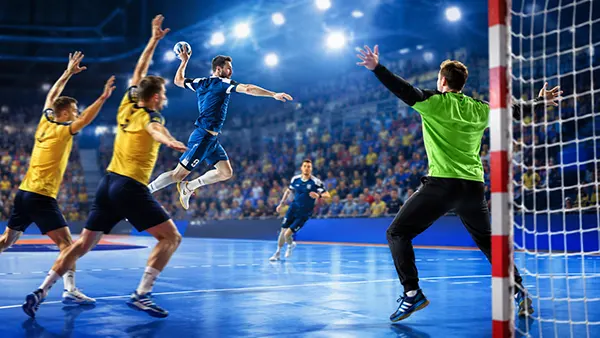
The quickest scoring sequences usually begin before a positional defence is properly established. A goalkeeper save, blocked shot, technical error or intercepted pass can release a wing or back-court player into open space, where the resulting attempt may be much cleaner than a shot against an organised six-player defensive block. Fast teams also tend to restart quickly after conceding, limiting the opponent’s opportunity to make defensive substitutions. A match in which both teams repeatedly run after possession changes can therefore develop a self-reinforcing rhythm: faster attacks create more possessions, more possessions create more turnovers and saves, and those events create further transition opportunities. The final number of goals may rise even if neither side is exceptionally efficient from ordinary positional attacks.
Pace should not, however, be confused with attacking quality. A team can play quickly and still produce a low-scoring period if its attacks end with rushed shots, poor angles or technical errors. The useful question is not simply how quickly a side attacks, but what its speed produces. Fast movement that consistently creates wing shots, breakthroughs, seven-metre throws or uncontested transition attempts is more relevant to a totals assessment than rapid but disorganised possession. The same principle applies to slow attacks. A patient side with excellent back-court shooting and strong pivot play can remain highly efficient despite using more time per possession. Pace mainly changes the number of opportunities available; shooting quality determines how successfully those opportunities become goals.
How to Read Tempo Before and During a Match
Before a match, recent scores provide a starting point but should not be treated as a complete measure of tempo. It is more useful to examine how those scores were produced. Frequent fast-break goals, high shot volumes, repeated turnovers and games in which both sides quickly reach the opponent’s nine-metre area are stronger signs of an open style than a single unusually high final score. Opponent quality also matters. A team may have produced several high totals because previous opponents repeatedly lost possession, while the next opponent may protect the ball better and retreat into defence more efficiently. Looking across several matches reduces the risk of treating one exceptional result as the team’s normal attacking rhythm.
Live observation can reveal changes that pre-match averages cannot show. The first ten to fifteen minutes provide useful information about how quickly each goalkeeper releases the ball, whether wings immediately sprint forward after possession changes and whether the defending side successfully stops the first transition. A score of 8-7 after ten minutes looks like a simple 90-goal pace if multiplied mechanically across the match, but that projection can be misleading. Several early fast breaks or seven-metre throws may have produced an unsustainably efficient spell. Conversely, a relatively modest early score can hide a genuinely quick match if both teams are generating many good attempts but the goalkeepers are saving at an unusually high rate.
Game state also changes tempo. A team protecting a four- or five-goal advantage late in the second half has less reason to attack immediately after every restart, while the trailing side usually needs quicker possessions and may apply more aggressive defence to regain the ball. Handball does not allow unlimited possession simply because a team wants to slow the match. Under the IHF rules used in 2026, referees can signal passive play when an attack is no longer making a recognisable attempt to create a scoring opportunity. After that warning, the attacking team normally has a maximum of four passes to produce a shot before possession can be awarded to the opponent. This limits extreme time-wasting, but meaningful differences in attacking pace still remain between teams and match situations.
How Two-Minute Suspensions Change the Scoring Environment
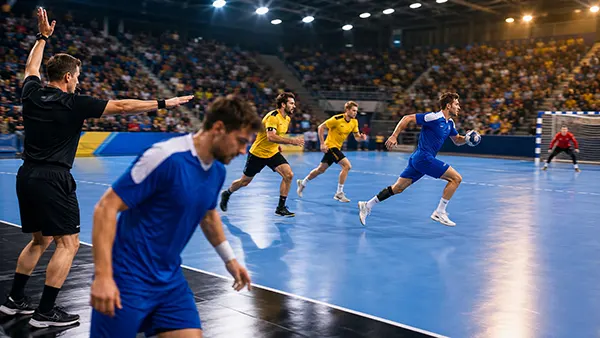
A two-minute suspension is one of the clearest short-term changes to the structure of a handball match. The suspended player cannot participate and cannot simply be replaced during the suspension, leaving the team with one fewer player on the court. Two minutes may appear short, but it represents roughly 3.3% of the normal 60-minute playing time. A single exclusion can therefore cover several possessions, while overlapping suspensions can create an even more unusual numerical situation. For totals betting, the important detail is that the effect is not restricted to the team receiving the penalty. Both teams often change their attacking choices, substitution patterns and risk level until full strength is restored.
The team with the numerical advantage normally has more space to attack. Defensive gaps become wider, particularly when the ball is moved quickly from one side of the court to the other. The pivot can become harder to control, wings may receive wider shooting angles and back-court players have more room for breakthroughs. This can increase the probability of a high-quality attempt, but an automatic goal should never be assumed. Some teams execute six-against-five attacks far better than others, while disciplined defensive sides can reduce the damage by staying compact and forcing shots from less favourable positions. Goalkeeper performance can also erase much of the expected advantage during a short two-minute period.
The suspended team has several choices in attack. It can play conservatively with five outfield attackers and a goalkeeper, using longer possessions to reduce the number of attacks played while short-handed. It can also remove the goalkeeper for an additional court player. Current IHF rules permit teams to play without a goalkeeper, subject to the limit on the number of players allowed on court. During a standard single suspension, this can allow the short-handed side to attack with six court players against the opponent’s six field defenders. The cost is obvious: losing possession can expose an empty goal. As a result, one suspension may reduce attacking tempo in one match but contribute to rapid exchanges and empty-net goals in another.
Why the Timing and Response to a Suspension Matter
The minute in which a suspension occurs can be almost as important as the suspension itself. An exclusion in the opening ten minutes takes place when both teams still have substantial time to adjust, while an exclusion with two or three minutes remaining can directly influence the final sequence of possessions. Late suspensions are particularly relevant when the score is close. The leading team may try to use longer possessions, whereas the trailing team may need to defend aggressively and attack quickly. When a side is already behind by several goals, a suspension can increase its need to take risks, so the scoring effect may continue after the player returns rather than ending precisely when the two-minute period expires.
Multiple exclusions deserve separate attention. If suspensions overlap, the available space and tactical choices can change sharply. The team with the advantage may be able to create a clear chance after only a few passes, while the short-handed defence must cover larger areas with fewer players. Yet an extreme numerical advantage can occasionally slow the game because the stronger side becomes more selective and waits for an almost certain opportunity instead of forcing an early shot. This is one reason why counting exclusions alone is insufficient. A bettor needs to know which team is short-handed, how long remains on the penalty, whether another suspension overlaps it and how the teams have handled similar situations during the match.
Live totals can move quickly after a red card, two-minute suspension or run of fast goals, so the informational value of an event depends partly on whether the market has already adjusted. Seeing a suspension and immediately assuming that an over bet has become stronger can mean reacting to information already reflected in the new total. A better assessment considers what is likely to happen during the next several possessions. If a strong six-against-five attack faces a defence that has already struggled to cover the wings, the numerical advantage has clear relevance. If the short-handed team is deliberately slowing possession and the opponent is comfortable controlling the match, the same two-minute penalty may have a smaller effect on total scoring.
Combining Pace and Suspensions When Assessing Handball Totals
Pace and suspensions are most useful when considered together rather than as separate signals. A fast match is particularly sensitive to numerical advantages because each two-minute period may contain several attacking sequences. If both teams are already restarting quickly and generating transition chances, an exclusion can create another layer of instability. A slow positional match behaves differently. The team with possession may use a substantial part of the suspension on one or two controlled attacks, reducing the number of situations in which the numerical advantage can influence the score. The same penalty therefore has a different potential value depending on the rhythm that existed before the referee raised two fingers.
A practical assessment can begin with a baseline expectation for the match and then ask what has genuinely changed. Before kick-off, consider the usual attacking speed of both teams, their ability to prevent counterattacks, recent scoring patterns and the likely competitive balance. During the match, update that view using the quality and frequency of chances rather than the scoreboard alone. A 16-14 first half may support a moderate full-match total in one contest, but in another it may hide ten goalkeeper saves from clear positions and indicate that the teams are creating enough chances for scoring to accelerate. Conversely, 18-17 at half-time can overstate the sustainable pace if an unusual number of goals came from turnovers and temporary numerical advantages.
Different betting markets also react differently to these factors. A suspension against a weak defensive team may strengthen the case for the opponent’s team total more directly than for the overall match total, because the short-handed team might respond by slowing its own attacks. First-half and second-half totals should also be treated separately when game state changes. A favourite that establishes a large lead can reduce its transition frequency later, while an underdog chasing the score may use faster attacks and more aggressive defensive tactics. There is no fixed formula that converts one suspension or one fast ten-minute spell into a certain number of additional goals. The purpose of analysing pace is to understand how many opportunities are being created; the purpose of analysing suspensions is to judge how the quality and distribution of those opportunities may change.
A Practical Method for Reading Handball Totals More Accurately
A useful live assessment can be built around four questions: how often the teams are attacking, what type of chances those attacks are producing, which side is affected by suspensions and what the current score requires tactically. Imagine that twelve minutes have been played and fifteen goals have already been scored. A simple mathematical projection produces a very high full-match figure, but the number alone says little about sustainability. If most of those goals came from ordinary positional attacks and both teams continue to move the ball quickly, the early pace may have genuine significance. If five goals resulted from temporary numerical advantages and several others followed uncharacteristic turnovers, the opening period may be less representative of the remaining match.
Goalkeeper performance should be considered alongside these signals rather than treated separately. A match can have fast tempo and strong chance creation while remaining temporarily below an expected total because both goalkeepers start exceptionally well. The reverse can also occur when ordinary shooting opportunities produce an unusually high conversion rate. Watching where shots come from helps distinguish the two situations. Repeated clean breakthroughs, open wing attempts and uncontested fast breaks are more likely to support continued scoring than a sequence of difficult long-range shots that happen to beat the goalkeeper. The same reasoning applies during suspensions: the important evidence is not merely that one team has an extra player, but whether that advantage is actually producing better attempts.
No pace indicator or disciplinary pattern removes the uncertainty from handball betting. A few goalkeeper saves, technical errors, missed seven-metre throws or tactical changes can alter the final total substantially, and short live samples are especially vulnerable to random variation. The most reliable approach is therefore to use attack tempo and two-minute suspensions as contextual information rather than automatic betting signals. Compare what is happening on court with the current total, consider whether the market has already reacted and avoid increasing stakes simply because a short sequence appears favourable. Handball is fast enough for the scoring environment to change repeatedly during one match, so disciplined interpretation of those changes is more useful than trying to turn every exclusion or scoring run into a prediction.